Restoring proper rotation is the most critical first step when treating shoulder pain. So in this article I will review a Shoulder External Rotation PAILs RAILs exercise that I use in my clinic.
Then in a follow-up article I will review how to use and apply these same procedures to target shoulder internal rotation.
But first, let’s review why targeting shoulder rotation is so important.
Here’s Why Shoulder Rotation Is So Critical
In mathematics the “order of operations” is a strict set of rules often remembered by the acronym BEDMAS. This rule tells us that if we want to arrive at the correct solution we need to solve things in a certain order. First brackets, then exponents, then multiplication/division, and finally addition and subtraction.
Treating joint pain and dysfunction is the same. Things need to be done in certain steps.
And when treating the shoulder before I worry about things like scapular stability or rotator cuff strength, the first thing I focus on is making sure the shoulder can rotate fully into both internal and external rotation.
Why is this rotation so important?
Because when rotation is limited it indicates that the deep structures of the shoulder — the glenohumeral ligaments and capsule, and the rotator cuff muscles — are dysfunctional.
And when this is the case the dysfunction will carry-over to other accessory shoulder motions such as flexion-extension and abduction-adduction.
Developing Shoulder External Rotation
What this means for us as therapists and clinicians is that we had better know what to do to restore normal shoulder rotation.
Of course, manually therapy an be extremely helpful here to target these deeper glenohumeral structures ( I find ART and FR can be very effective here). But these alone won’t be enough.
Home exercise prescription is also important here to establish a consistent (i.e., daily) stimulus to promote change in the shoulder.
So in this article I will review a Shoulder External Rotation PAILs / RAILs exercise that I use. In a follow-up article I will review how to use and apply these same procedures to target shoulder internal rotation.
Seated/Supported GHER PAILs/RAILs
The Seated/Supported GHER PAILs/RAILs exercise is the primary exercise I use to help improve shoudler external rotation.
PAILs (Progressive Angular Isometric Loading) and RAILs (Regressive Angular Isometric Loading) are mobility exercises that utilize isometric contractions performed at limited joint ranges. These active muscular contractions improve flexibility faster than static stretching by engaging the nervous system to relax tight muscles on the opening/progressive side of the joint.
But that’s not all. Utilizing these isometric contractions on the closing/regressive side can help to develop strength and control of muscles responsible for creating this joint position and ensuring the joint is protected and stabilized.
To perform the exercise…..
The set-up is key here. We want the elbow to be supported just below shoulder height. This can be done from a kneeling position as shown here. Sitting sideways in a chair with the arm supported on the back of the chair is another position I often prescribe.
From this supported position the forearm rotates back to create external rotation.
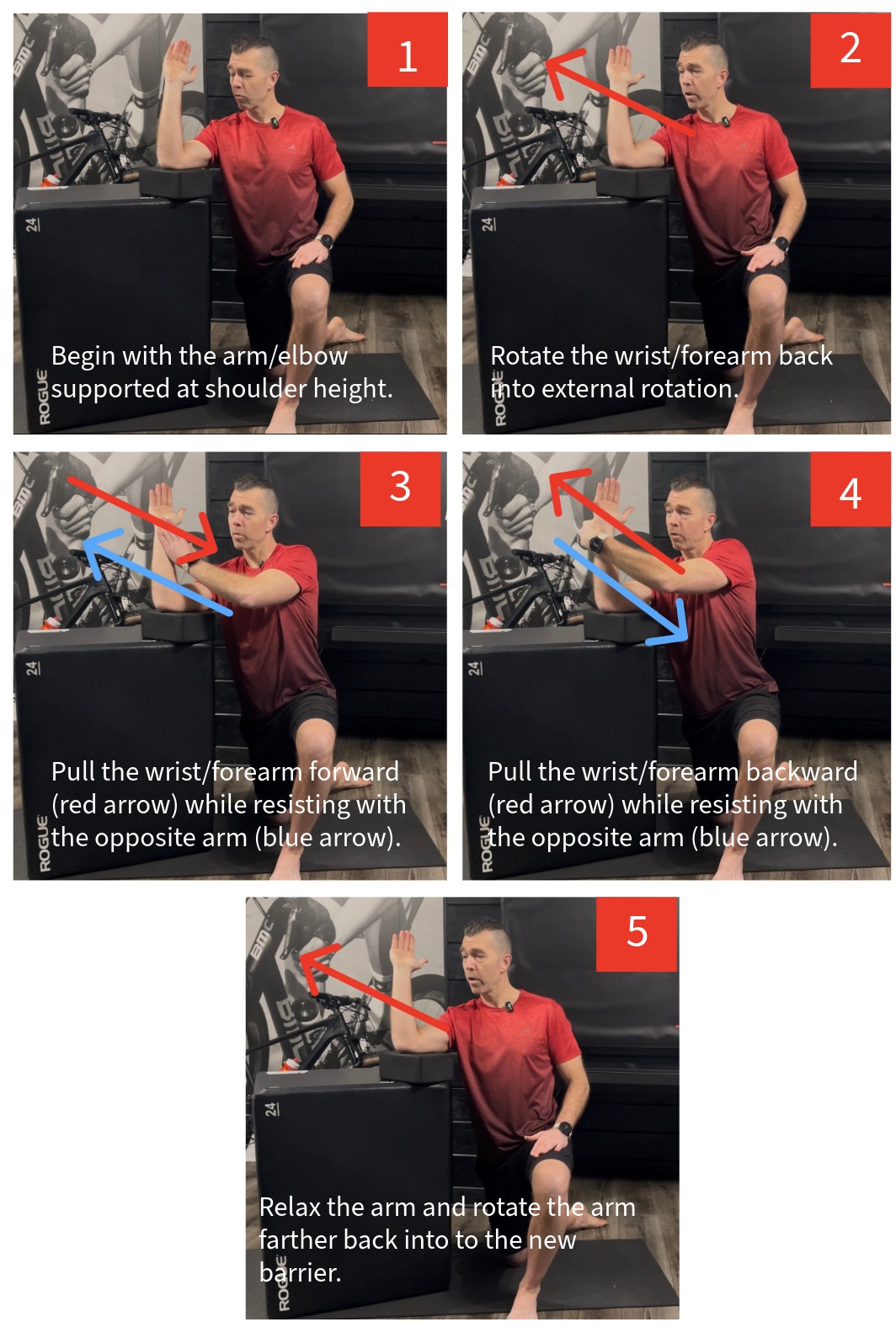
From this position we will add our isometric contractions. Using the opposite arm as resistance, the hand and forearm are actively rotated forward (we are pulling the shoulder into internal rotation), but this force is resisted by the opposite arm. Hold for 8-10 seconds.
Now place the opposite hand is positioned towards the back of the wrist, and the hand and forearm are actively rotated back (into external rotation). This force is again resisted by the opposite hand so there is no joint movement. Hold for 8-10 seconds.
As the muscles relax the shoulder is then rotated farther back into external rotation to take up the slack created by the isometric contractions. This positon can then be held for 8-10 seconds.
Programming
Typical programming would be to perform 3-5 cycles. I find it very effective to combine this exercise with a targeted shoulder mobility sequence done on a daily basis.