In this article I’m going to review the Scapular Retraction Rehab Progressions that I use to retrain scapular posture and develop strength and endurance.
Of course we all know that poor scapular strength and posture is one of the most common things we see in our clinics. Rounded shoulders and a protracted scapula are a massive problem with so many non-traumatic presentations of neck, upper back, and shoulder pain.
But targeting and correcting scapular function is not always easy, because muscle compensations are common, even with targeted rehab exercises.
In fact, even some of the most common exercises that supposedly target scapular retraction (exercises like “T’s”, “Y’s” and “W’s) can place the emphasis on the wrong muscles.
If this occurs not only will the exercises be less effective, but in many cases will simply reinforce the compensations we are trying to correct.
So in this article I’m going to review the Scapular Retraction Rehab Progression I use to target this common dysfunction.
Scapula Retraction Rehab Progressions
The key here is to progress the exercises in order to ensure proper form and the correct muscle contraction patterns are developed first (as done in exercise 1). Only once the proper pattern has been established can we then work on developing strength and endurance.
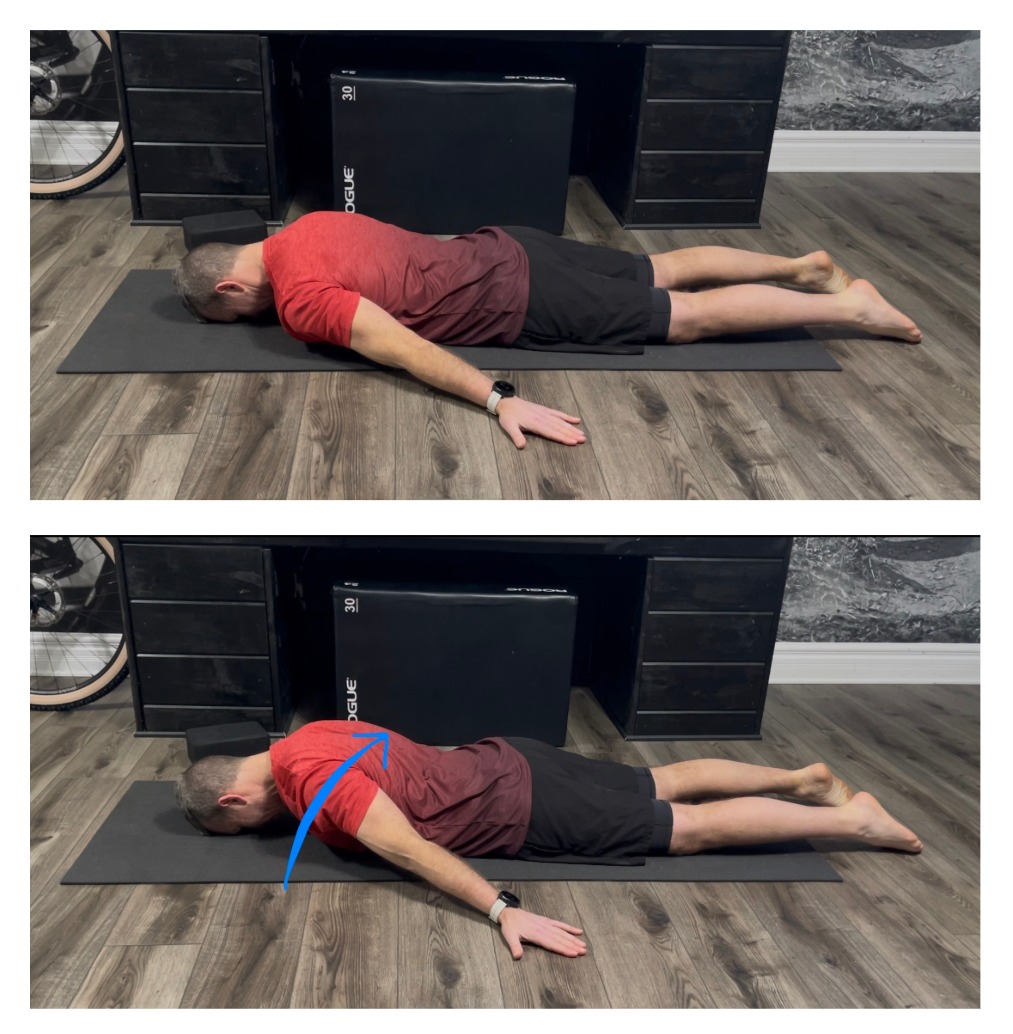
Exercise 1: Prone Scapular Retraction Lift Off
The real key with correcting and training scapular retraction is ensuring the right muscles are performing the movement.
We want the motion to be created by the scapulo-thoracic muscles (lower trapezius and rhomboids), and NOT the scapulo-cervical muscles (levator scapulae and upper trapezius).
To help with this we are going to restrain the ability to elevate the scapula by starting in a prone position with the palm resting on the floor. From this starting position the patient/client is cued to simply pull the shoulder blade back and down along the posterior thoracic wall.
Proper cueing is important here. When learning the motion it is helpful to assist the motion by manually guiding the scapular into the desired position. Here we would pull the front of the shoulder up and back off the floor while the lower corner of the shoulder blade slides down and in towards the spine and “into” the thorax.
The other key is to retract the scapula as far as possible. It is at the end range where they will feel the appropriate tension in the lower trap and rhomboids.
This tension is held for 5 seconds, then the anterior shoulder is lowered back to the floor. It is critical they learn to “feel” this tension as it will be needed in the following progression.
It is also important to keep the neck and upper scapular muscles relaxed. The therapist needs to assess the tension in these muscles during the motion. If there is excessive tension here it needs to be corrected.
Programming
The main purpose of this exercise is to develop the proper movement pattern and start to establish neural communication. Typical prescription here would be to perform 1-2 sets of 10 slow, deliberate repetitions 1-2x/day.
Exercise 2: Prone Scap Retraction w/ Arm Lift Off
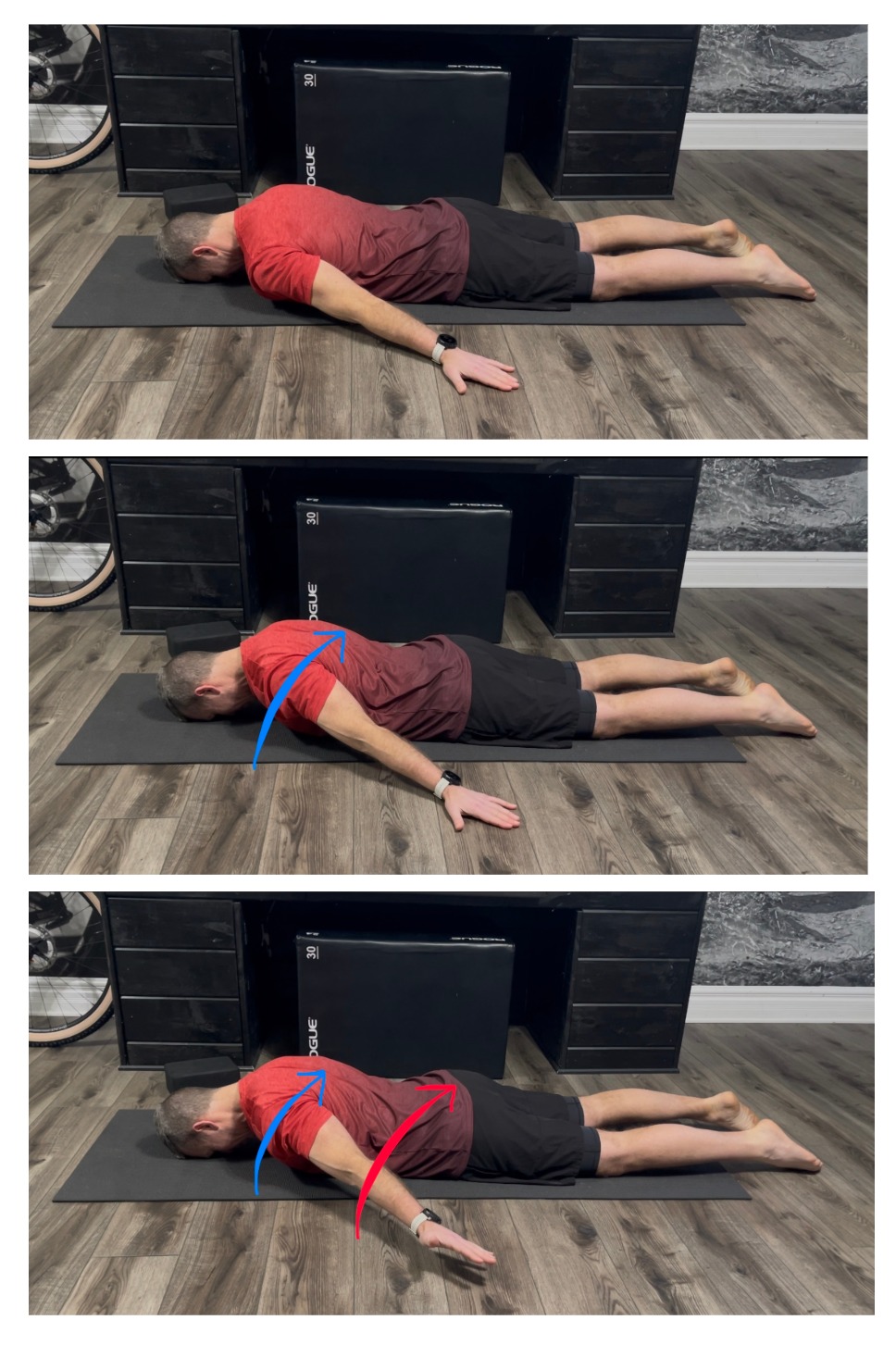
The Prone Scap Retraction w/ Arm Lift Off exercise uses the scapular positioning and muscle activation pattern we developed in the first exercise, but starts to train strength and endurance by adding resistance.
This exercise starts with lying prone with the palm down, then pulling the scapula back into retraction. This is the same as the first exercise.
But now, from the retracted position, the patient/client then lifts the arm up so the hand comes off the floor.
It is this unsupported arm position that adds resistance, as the scapular muscles must now maintain the retracted position against the downward pull created by elevated arm.
The key here is to keep the focus on the scapula, not the arm. The patient’s conscious effort should be maintaining active tension in the scapula muscles to keep the shoulder blade retracted towards the spine and into the thoracic wall.
Programming
A typical exercise prescription would be to perform 10 second holds, performing 3 sets of 6-8 repetitions. This would be repeated 2-3x/week.
Exercise 3: Prone Scap Retraction Hovers
With Prone Scap Retraction Hovers we are furhter increasing both the muscular demand as well as adding an additional motor control challenge.
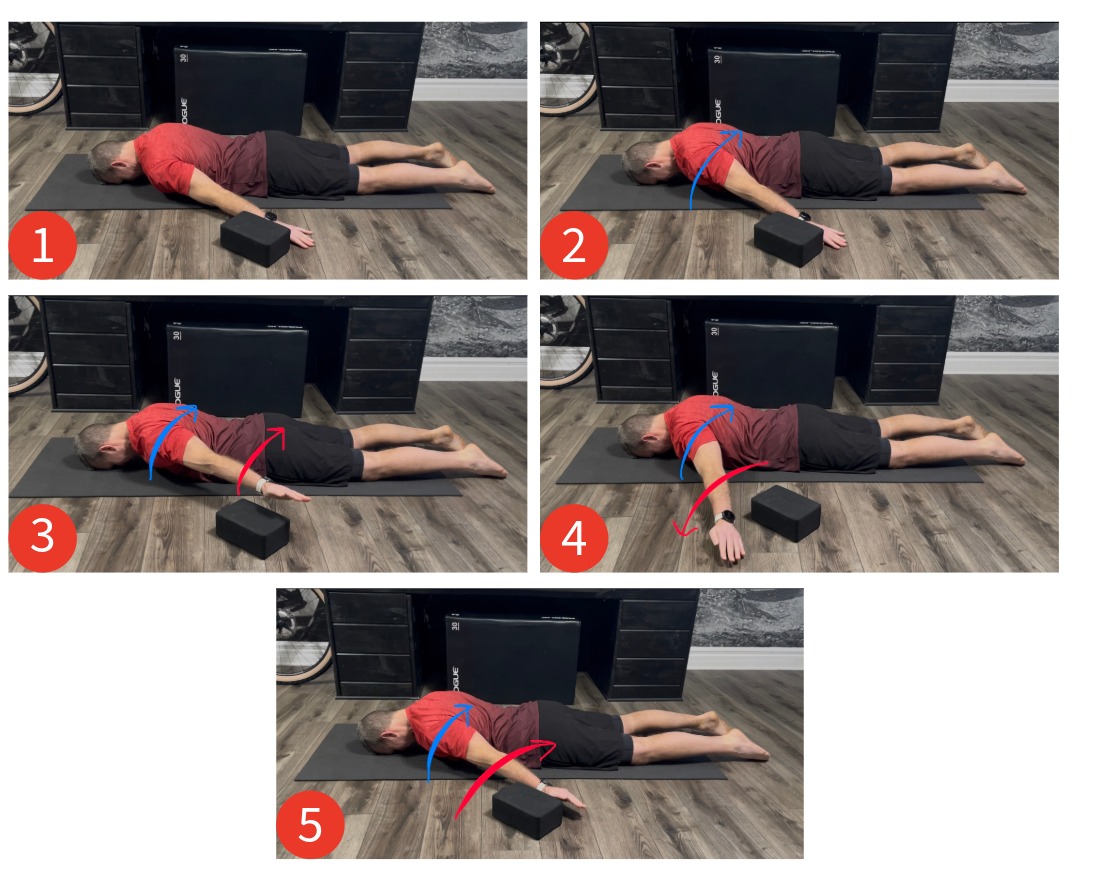
From a prone position we will place blocks on the floor. These blocks are placed at the level of the lower forearms/wrists if the arms were resting 45 degrees out from the trunk. (The exact height of the blocks can be varied, with higher positioning being more challenging).
The scapula is pulled back to set the retracted position, and the arm is lifted off the floor, just as was done in the previous exercise.
From this lifted posting the hand and wrist are the brought over the block, then brought back down to the floor on the opposite side of the block.
The hand would then be lifted and brought over the blocks again. Ideally the scapular would be held in a retracted position for the duration of the exercises, but stopping to reset scapular retraction may be needed for some patients/clients, especially with learning the motion.
Not only will this increase the muscles demands on the muscles themselves, but also provides an additional motor control challenge as this requires an isometric/static contract at the scapular muscles paired with dynamic contraction/control of the posterior shoulder muscles.